
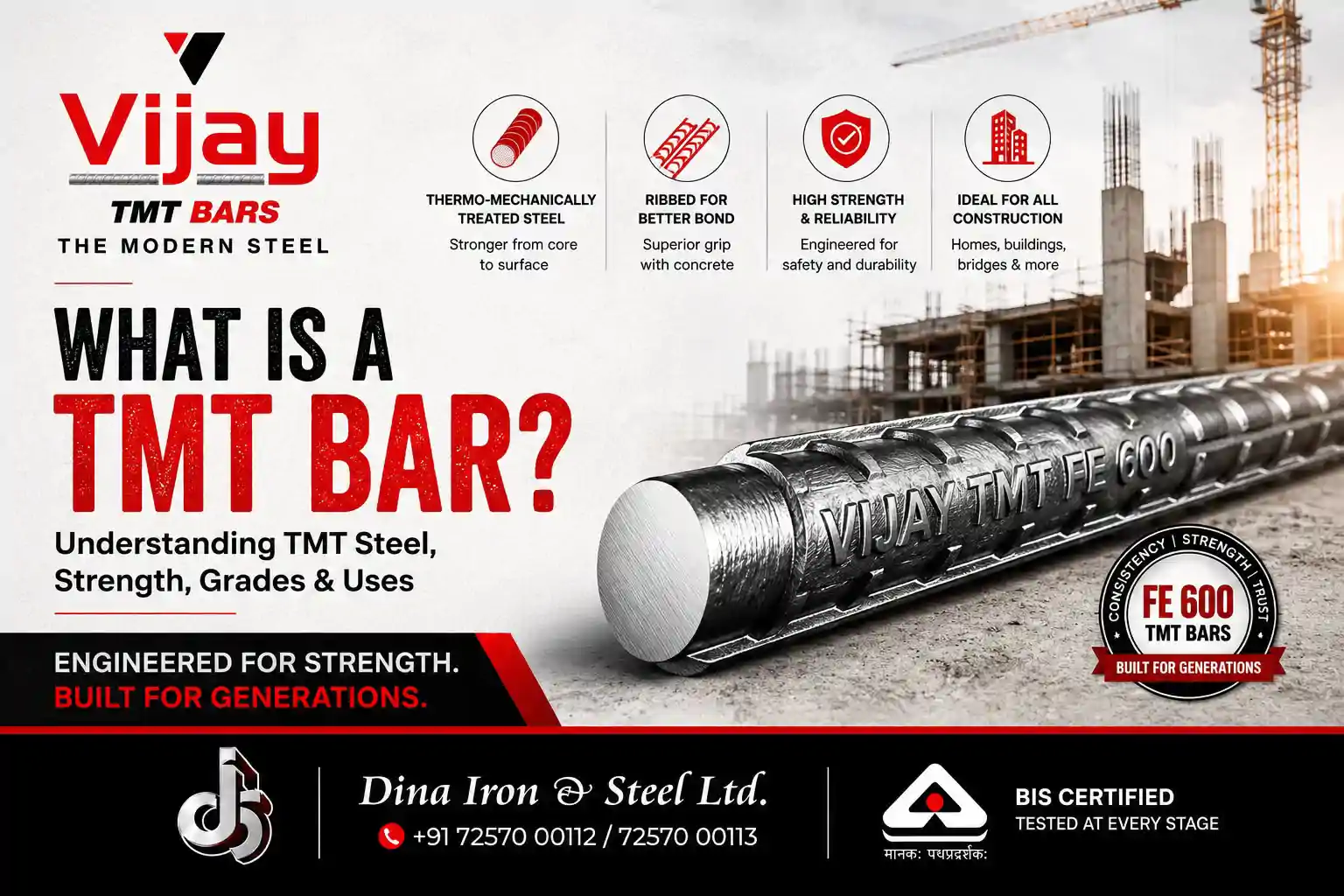
What Is a TMT Bar? Understanding TMT Steel, Strength, Grades & Uses | Vijay TMT
What is a TMT bar and why is it used in construction? Understand TMT steel, how thermo-mechanical treatment works, what Fe grades mean, and why TMT bars are essential for reinforced concrete.Team Vijay TMT | Dina Iron & Steel Ltd | Since 1992
What Is a TMT Bar?
If you've ever visited a construction site, you've probably seen long steel bars with a ribbed surface stacked beside the building.
These are TMT bars—Thermo-Mechanically Treated steel bars.
TMT bars are high-strength deformed steel reinforcement used in reinforced concrete structures. Their purpose is not to replace concrete, but to work together with it.
Concrete is strong in compression, while reinforcement steel provides the tensile reinforcement needed in structural members.
The combination allows materials with different properties to work together as reinforced concrete.
TMT bars are commonly used in elements such as columns, beams, slabs, foundations and walls, as well as many larger infrastructure applications. BIS's material on IS 1786 describes high-strength deformed steel bars as reinforcement for concrete and highlights their use in structural applications. Bureau of Indian Standards
What Does TMT Stand For?
TMT stands for Thermo-Mechanically Treated.
The name describes the controlled thermal and mechanical processes used to produce the finished reinforcement bar.
In simple terms, hot-rolled steel undergoes controlled cooling and subsequent temperature equalisation that develops the required combination of strength and ductility.
The result is a bar with engineered mechanical properties suitable for reinforced concrete construction.
In simple words:
TMT isn't just a type of steel.
It describes a manufacturing and treatment process used to develop the properties of reinforcement steel.
Why Do TMT Bars Have Ribs?
The ribs on a TMT bar are not just a design feature.
They are deformations engineered into the surface of the reinforcement bar.
Their purpose is to improve the mechanical interaction between the steel and surrounding concrete.
When a reinforced concrete member carries a load, the steel and concrete need to work together. The deformed surface helps transfer forces between the two materials.
This is why TMT bars look very different from a smooth steel rod.
BIS's material for IS 1786 specifically addresses deformation and surface characteristics and also includes requirements related to rib area and bond strength. Bureau of Indian Standards
Simple takeaway:
The ribs help the steel grip the concrete.
How Does the TMT Process Work?
The TMT process is easier to understand when broken into a few stages.
1. Hot Rolling
Steel is heated and passed through a rolling mill to produce the required bar size and shape.
2. Controlled Cooling
Immediately after rolling, the hot bar undergoes controlled cooling.
3. Temperature Equalisation
The heat remaining in the core moves outward as the bar continues cooling.
4. Final Structure
This controlled thermal process produces the combination of surface strength and a more ductile core associated with TMT reinforcement.
The exact manufacturing process depends on the manufacturer's technology and process controls. IS 1786 itself permits more than one production route, including hot-rolled steel with controlled cooling and tempering. Bureau of Indian Standards
For a detailed look at the complete manufacturing journey, see:
How TMT Bars Are Manufactured: The Complete Step-by-Step Guide from Raw Materials to Finished Steel
Why Are TMT Bars Used in Construction?
A building is subjected to different types of forces throughout its life.
Concrete handles compression effectively, but structural members can also experience tensile stresses.
Reinforcement steel helps provide the tensile capacity required in reinforced concrete.
TMT bars are therefore used to reinforce structural elements and help them perform as designed.
Their important characteristics include properties such as:
- Yield strength
- Tensile strength
- Elongation
- Ductility
- Bend and rebend performance
- Deformation characteristics
These are not simply visual qualities. They are measurable properties covered by applicable standards and testing. BIS's product manual for IS 1786 lists proof stress, percentage elongation, tensile strength, bend and rebend tests among the applicable quality checks. BIS
What Do Fe 500, Fe 550 and Fe 600 Mean?
This is one of the most common questions people have when they first encounter TMT bars.
The "Fe" refers to iron, while the number in the grade designation corresponds to the specified minimum yield/proof stress in N/mm² under IS 1786.
For example:
Fe 600 → specified minimum yield/proof stress of 600 N/mm².
IS 1786:2008 includes Fe 415, Fe 415D, Fe 500, Fe 500D, Fe 550, Fe 550D and Fe 600 among its strength grades. Bureau of Indian Standards
An important point:
A higher number does not automatically mean that the grade is appropriate for every structure.
The required grade should be determined by the structural design and specifications for the project.
That is why homeowners shouldn't independently choose a grade simply because the number is higher.
What Is Fe 600 TMT Bar?
Fe 600 is a high-strength reinforcement steel grade specified under IS 1786.
The "600" refers to the specified minimum yield/proof stress of 600 N/mm² in the grade designation. Bureau of Indian Standards
Fe 600 can provide high strength while still needing to satisfy the other applicable requirements of the standard, including requirements relating to tensile properties, elongation, dimensions, deformation and testing.
At Vijay TMT, our product focus is FE 600 TMT bars.
This means our educational content can go beyond simply saying "higher strength."
We can explain what the grade actually means and why strength must always be considered alongside the other properties required for reinforcement steel.
Is Higher Strength Always Better?
Not necessarily.
This is an important distinction.
TMT bar performance is not defined by one number alone.
A structural engineer considers the requirements of the project and selects the appropriate reinforcement grade and size.
Other properties matter too, including:
- Ductility
- Elongation
- Tensile behaviour
- Bendability
- Deformation characteristics
- Chemical composition
A TMT bar should therefore be evaluated as a complete engineered product, not simply by asking which grade has the highest number.
This is also why our first article discusses why consistency matters alongside strength.
Where Are TMT Bars Used?
TMT reinforcement bars are used across a wide range of reinforced concrete construction.
Residential Construction
- Foundations
- Columns
- Beams
- Slabs
- Staircases
- Walls
Commercial & Industrial Construction
- Commercial buildings
- Industrial structures
- Warehouses
- Foundations
- Large reinforced concrete structures
Infrastructure
TMT reinforcement is also used in various infrastructure applications where reinforced concrete is required.
The specific bar grade, diameter and reinforcement arrangement should always follow the structural design.
TMT Bar vs Ordinary Steel Rod: What's the Difference?
The terms are sometimes used interchangeably in everyday conversation, but they don't describe the same thing.
A TMT bar is a deformed reinforcement bar manufactured to specified requirements for use in reinforced concrete.
Its ribbed surface and controlled manufacturing process are important parts of its design.
The term "steel rod" is much broader and can refer to many different steel products that may have different compositions, manufacturing processes and intended uses.
So when someone says:
"I need steel rods for my house,"
the important next question is:
"What reinforcement steel has been specified for the structure?"
For reinforced concrete, the relevant product and grade should be selected according to the structural design.
What Should a Homeowner Look for in a TMT Bar?
You don't need to become a metallurgist before building your home.
Start with the fundamentals:
1. Applicable Standard
Check that the product complies with the applicable Indian Standard.
2. Correct Grade
Use the grade specified for your project.
3. Manufacturer
Know who actually manufactured the steel.
4. Product Identification
Check markings and product identification.
5. Manufacturing Quality
Prefer manufacturers that maintain systematic quality control throughout production.
6. Testing
Choose manufacturers that verify important product properties through appropriate testing.
This is why our previous guide explains how to check TMT bar quality before buying.
The Vijay TMT Perspective
At Vijay TMT, we believe understanding steel shouldn't be difficult for the people who build with it.
That's why we believe the best way to talk about TMT bars is to explain what they are, how they are made, what their grades mean and what quality actually involves—without unnecessary technical jargon.
Our manufacturing journey begins well before the finished TMT bar reaches a construction site.
From raw materials and steel melting to billet production, billet verification before rolling, controlled rolling, thermo-mechanical treatment and finished-product testing, each stage contributes to the final product.
Our focus is FE 600 TMT bars, manufactured with an emphasis on strength, consistency and controlled production.
Because modern construction deserves steel that is understood—not simply sold.
TMT Bars: The Simple Explanation
If you remember only five things from this guide, remember these:
TMT = Thermo-Mechanically Treated steel.
TMT bars reinforce concrete by providing the required tensile reinforcement.
The ribs help create mechanical interaction between steel and concrete.
Fe 600 is a high-strength grade with a specified minimum yield/proof stress of 600 N/mm² under IS 1786. Bureau of Indian Standards
The right TMT bar is not simply the one with the highest number—it is the product that meets the requirements of the structural design and applicable standards.
Frequently Asked Questions
What is a TMT bar?
A TMT bar is a Thermo-Mechanically Treated, high-strength deformed steel reinforcement bar used in concrete construction.
What does TMT stand for?
TMT stands for Thermo-Mechanically Treated.
Why are TMT bars used in concrete?
TMT bars provide reinforcement to concrete, particularly to resist tensile stresses, allowing steel and concrete to work together in reinforced concrete structures.
Why do TMT bars have ribs?
The ribs are surface deformations that help improve the mechanical interaction and bond between reinforcement steel and concrete. Bureau of Indian Standards
What does Fe 600 mean?
Under IS 1786, the 600 in Fe 600 refers to the specified minimum yield/proof stress of 600 N/mm². Bureau of Indian Standards
Is Fe 600 better than every other TMT grade?
Not automatically. The appropriate grade depends on the structural design and project requirements. Different grades have different specified mechanical properties.
What is the difference between TMT and normal steel bars?
TMT bars are deformed reinforcement bars manufactured and treated to achieve specified properties for reinforced concrete. "Normal steel bar" is a broad term and does not necessarily identify a specific reinforcement product or standard.
What is IS 1786?
IS 1786 is the Indian Standard for High Strength Deformed Steel Bars and Wires for Concrete Reinforcement. It specifies requirements for grades including Fe 600 and covers areas such as mechanical properties, dimensions, deformation characteristics and testing. Bureau of Indian Standards
What grade of TMT bar should I use for my house?
Use the grade specified by the structural engineer for your project. The appropriate grade depends on the structural design rather than simply choosing the highest available grade.
What grade does Vijay TMT manufacture?
Vijay TMT manufactures FE 600 TMT bars.
Conclusion
TMT bars may look simple once they arrive at a construction site.
But behind every bar is a combination of steel chemistry, manufacturing, rolling, thermal treatment, engineering and testing.
Understanding those fundamentals helps homeowners, builders, contractors and engineers make better-informed decisions.
And that's the purpose of the Vijay TMT Knowledge Centre:
To make steel easier to understand—so you can make better decisions about what goes into the structures you build.
Vijay TMT — The Modern Steel.
Since 1992.